
Search Washington Inmate Records
The Washington correctional system comprises different facilities used to detain individuals awaiting trial or serving sentences. The system consists of county jails, state prisons, federal correctional institutions, and private prisons. Currently, there are 11 state prisons and 52 county jails. Similarly, the state has a federal detention center and a private prison.
Washington State has three female detention centers housing women who have been incarcerated for various criminal offenses. Likewise, the state has 10 residential facilities catering to high-risk minors convicted of crimes in the state.
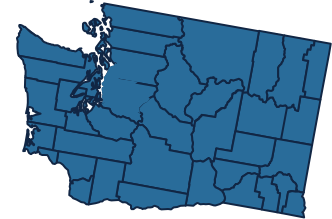


Washington Department of Corrections Inmate Search
The Washington Department of Corrections (WADOC) is responsible for overseeing the state's prison system. The WADOC manages the operations of state prisons and correctional facilities. It ensures the safety and security of inmates and staff. It also provides rehabilitation and educational programs to help inmates reintegrate into society after release. The WADOC collects, maintains, and provides access to inmate information.
The WADOC maintains an online database of inmate information known as the Incarcerated Search. The web tool provides access to information on currently incarcerated individuals. It offers information on the name, age, incarceration location, and details of the offense.

Find Inmate by Name
Inmate records are accessible by name on the WADOC Incarcerated Search tool. The tool permits users to search the database by first or last name. Entering the first and last name into the search tool locates the specific inmate record. However, where only one name or part of a name is known, the result will show all names that match the search criteria. For example, entering Will as the first name will turn up names that include Will, such as William, Willie, and Sherwilliam.

Find Inmate by Number
Inmate records are also accessible using the inmate number. Referred to as the DOC number (Department of Corrections Number) in Washington, it is a six-digit number assigned to each inmate. The DOC number is used to identify incarcerated persons and may be used to locate inmate records on the Incarcerated Persons search tool. Where the DOC number is unknown, searchers may scan through the inmate search result to locate the specific inmate record.
How Many Inmates Are Currently Incarcerated in Washington?
Washington has an estimated incarcerated population of ~29,400 people across state prisons, county jails, federal facilities, private detention facilities, juvenile facilities, and other detention categories.
Figures are approximate because daily jail counts, pre-trial detention, and contract detention populations can change frequently.
| Facility Type | Population | % of Total | Avg. Daily Cost | Capacity Utilization |
|---|---|---|---|---|
| State Prisons | ~13,400 | 45.6% | ~$155 | ~96% |
| County Jails | ~10,200 | 34.7% | ~$130 | ~75% |
| Federal Facilities | ~1,250 | 4.3% | ~$145 | ~80% |
| Private Prisons | ~1,450 | 4.9% | ~$120 | ~85% |
| Juvenile Facilities | ~650 | 2.2% | ~$450 | ~55% |
| Other / Pre-Trial | ~2,450 | 8.3% | ~$110 | ~70% |
| Total | ~29,400 | 100.0% | ~$148 | ~84% |
State Correctional Facilities in Washington
Washington operates approximately 12 major state prison facilities, along with work-release centers and community supervision offices managed by the Washington State Department of Corrections.
The system includes general-population prisons, specialty units, women's institutions, minimum-security facilities, medical or behavioral health units, and work-release centers.
| Facility Name | Type | Location | Capacity | Population | Security Level |
|---|---|---|---|---|---|
| Washington State Penitentiary | State Prison | Walla Walla | ~2,200 | ~2,000 | Maximum / Close / Medium |
| Monroe Correctional Complex | State Prison | Monroe | ~2,400 | ~2,200 | Multi-Level |
| Coyote Ridge Corrections Center | State Prison | Connell | ~2,500 | ~2,300 | Medium / Minimum |
| Stafford Creek Corrections Center | State Prison | Aberdeen | ~1,900 | ~1,750 | Medium |
| Washington Corrections Center for Women | Women's Facility | Gig Harbor | ~740 | ~680 | Multi-Level |
| Mission Creek Corrections Center for Women | Women's Facility | Belfair | ~300 | ~270 | Minimum |
| Monroe Correctional Complex - Special Offender Unit | Specialty Facility | Monroe | ~400 | ~360 | Specialized Mental Health |
| Coyote Ridge Assisted Living Unit | Medical / Aged Facility | Connell | ~120 | ~100 | Minimum / Medical Support |
| Brownstone Work Release | Work Release Center | Seattle | ~70 | ~60 | Community Custody |
| Tacoma Community Justice Center | Community Corrections Facility | Tacoma | Varies | Community-based | Supervision / Reentry |
Inmate Demographics & Population Trends in Washington
Washington's incarcerated population is primarily male and concentrated in the 25 to 44 age range, with violent offenses making up a large share of the state prison population.
Compared with many states, Washington has a moderate imprisonment rate, but its prison population still reflects national trends in longer sentences for violent and sex offenses and racial disparities in incarceration.
| Demographic Category | Breakdown | Notes |
|---|---|---|
| Gender | Male ~92%; Female ~8% | Women make up a smaller but steady share of the prison population, largely housed at Gig Harbor and Mission Creek facilities. |
| Age Groups | 18-24: ~9%; 25-34: ~31%; 35-44: ~32%; 45-54: ~17%; 55+: ~11% | The population is aging gradually, increasing demand for medical and reentry services. |
| Race / Ethnicity | White ~55%; Black ~18%; Hispanic / Latino ~14%; Native American / Alaska Native ~6%; Asian / Pacific Islander ~4%; Other / Unknown ~3% | Black and Native American residents remain overrepresented compared with their share of the state population. |
| Top Offense Types | Violent ~58%; Property ~16%; Drug ~12%; Sex Offenses ~10%; Other ~4% | State prisons hold a higher share of people convicted of violent and longer-sentence offenses than county jails. |
| Avg. Sentence Length | ~7.5 years estimated average for prison sentences | Sentence lengths vary widely, with violent and sex offenses typically producing longer terms. |
| Recidivism Rate | ~30% to 35% within three years of release | Returns are often linked to new convictions, supervision violations, housing instability, and behavioral health needs. |
Parole, Release & Reentry Resources in Washington
Washington uses supervised release, community custody, earned-time credits, and limited parole-style review for certain eligible sentences through state correctional agencies.
Reentry support may include housing referrals, employment services, benefits restoration, behavioral health connections, and victim notification tools.
| Program / Resource | Description | Who It Serves | Contact / Access |
|---|---|---|---|
| State Parole Board | The Washington State Indeterminate Sentence Review Board reviews certain indeterminate, juvenile, and special sentence cases. | Eligible incarcerated people with qualifying sentence types. | Washington State Indeterminate Sentence Review Board |
| Good Time / Sentence Reduction | Earned release time may reduce confinement for eligible people who follow facility rules and complete approved programming. | Eligible people in Washington DOC custody. | Washington State Department of Corrections case managers |
| Parole Supervision | Community custody supervision is provided by DOC community corrections officers after release. | People released to supervision, including those with court-ordered community custody. | Local DOC Community Corrections Office |
| Reentry Housing | Housing referrals, transitional planning, and limited voucher-style assistance may be available through DOC and community partners. | People leaving prison or under community supervision who need stable housing. | DOC Reentry Division and assigned reentry staff |
| Employment Assistance | WorkSource Washington, Correctional Industries, and community providers support job readiness, training, and placement. | Returning citizens seeking employment or vocational training. | WorkSource Washington or DOC reentry staff |
| Benefits Restoration | Assistance may include Medicaid reactivation, food assistance, identification documents, and referrals to DSHS services. | People preparing for release or recently released from custody. | Washington DSHS, Health Care Authority, and DOC transition staff |
| Victim Notification Program | WA VINE provides automated custody status and release notifications for registered victims and the public. | Victims, families, advocates, and community members seeking custody updates. | WA VINE / Victim Information and Notification Everyday |
What Information is Contained in a Washington Inmate Record?
The WADOC provides an online searchable database to access inmate records in the state. Records on the platform are accessible using the inmate's name or DOC number. The following information is contained in a Washington inmate record.
- Name: The name is the primary identifier on inmate records. All inmate records contain the legal name of the record holder. Common names will result in duplicates. Therefore, searchers need to use the first and last names to look up inmate records to ensure the accuracy of the result.
- Register No: The registered number refers to the DOC number given to inmates at the time of incarceration. The DOC number is specific to an inmate and can be used to locate the specific inmate record. The DOC number forms part of the information accessible on arrest records.
- Age: Inmate records contain information on arrested persons' age. The age reported on the record reflects the inmate's current age, rather than their age at release. However, for deceased persons, the age shown reflects their age at death as well as the date released.
- Race: Inmate records contain information on the race of incarcerated persons. The race classifies inmates based on distinct inherited properties. Inmate race may be Asian, African American, Latino, Hispanic, Native Hawaiian, or White.
- Sex: Incarcerated persons' genders are recorded on inmate records.
- Release Date: The release date refers to the estimated date an inmate is scheduled to be released from custody. It also indicates the date the incarcerated person was released. Inmate records contain information about the expected date of release. However, this date may change based on behavior. Good behavior may reduce inmates' sentences, shortening the release date. However, engaging in illegal activities may elongate the sentence.
- Location: The location refers to the correctional facility housing incarcerated individuals. Inmate records contain information about the facility housing convicted persons and may sometimes include the city or region of the facility. The location may temporarily show "In Transit" for inmates moved from one WADOC facility to another.
Although the release date on inmate records refers to the official date when an individual is released from a correctional facility in Washington, some records may contain unknown release dates. An unknown release date implies that the date of release from custody is undetermined. Unknown release dates occur in cases where the inmate is awaiting trial or eligible for parole.
Parole refers to conditional release of inmates from correctional facilities after serving part of their sentence. However, parole systems are unavailable for crimes committed after 1984, in Washington. The state uses community custody, allowing persons convicted to serve part of their sentence in the community, instead of within a jail or prison facility. This approach allows community custody officers to monitor offenders while they live in the community, to help the offenders reintegrate into society.
Washington Inmate Records by Counties
Washington State maintains inmate records at the state and county levels. County jails maintain their records of incarceration occurring within their jurisdiction. In Washington, each of the 39 counties maintains its inmate records, separate from the state's prison records. County inmate records are accessible at the county sheriff's offices. Some county and sheriff's offices provide searchable online databases to access county jail inmate records. For instance, the Snohomish County Sheriff's Office provides an online searchable database, Inmate Search, to access inmate records. Others, such as Kittitas County may provide inmate listings or Jail Roster for individuals incarcerated in the county jail. Lastly, inmate records are also accessible from the county or sheriff's offices by mail, fax, email, or in person.
- Adams County
- Asotin County
- Benton County
- Chelan County
- Clallam County
- Clark County
- Columbia County
- Cowlitz County
- Douglas County
- Ferry County
- Franklin County
- Garfield County
- Grant County
- Grays Harbor County
- Island County
- Jefferson County
- King County
- Kitsap County
- Kittitas County
- Klickitat County
- Lewis County
- Lincoln County
- Mason County
- Okanogan County
- Pacific County
- Pend Oreille County
- Pierce County
- San Juan County
- Skagit County
- Skamania County
- Snohomish County
- Spokane County
- Stevens County
- Thurston County
- Wahkiakum County
- Walla Walla County
- Whatcom County
- Whitman County
- Yakima County
Are Incarceration Records Public Information in Washington?
Incarceration records are public information in Washington. The Washington Public Records Act permits state agencies, including the WADOC, to make available to the public any information relating to the conduct or performance of their governmental duties, except such records are excluded from the policy state or federal law. Consequently, incarceration records are open records. Members of the public may inspect or copy the records. Generally, record seekers may access information such as the inmate's first and last name, age, gender, race, ethnicity, inmate identification number, custody date, and custody status. Similarly, booking details, charges, and custody location information are open to the public.
Despite the state open records law, some information on inmate records is generally available to the public. Typically, such information is restricted by state or federal law and only becomes accessible based on a court order. Therefore, substance abuse treatment information and inmate medical records are closed to the public. Also, the state redacts personal identifiers such as inmates' Social Security numbers and home addresses to prevent fraud or potential harm to inmates.
Federal Prisons in Washington
The Federal Bureau of Prisons (BOP) manages all federal prisons in the United States, including Washington State. It ensures the safety and security of all federal inmates through strict security protocols and surveillance. The BOP also provides rehabilitation and educational programs to help inmates reintegrate into society. It runs work programs where inmates can learn practical skills to increase their chances of getting a job after release.
The BOP classifies federal prisons into 4 security levels: minimum, low, medium, and high. Minimum-security federal correctional institutions have less security and focus more on rehabilitation. On the other hand, high-security federal prisons, often called penitentiaries, have the highest security level with reinforced perimeters.
Presently, Washington has a federal prison, the Federal Detention Center (FDC), SeaTac. Located in Seattle, FDC SeaTac serves male and female inmates convicted of federal crimes. It also houses inmates awaiting trials for federal crimes. FDC SeaTac is an administrative-security prison. It accommodates inmates with unique security risks, such as persons with mental health issues, inmates in transit, or inmates with active judicial proceedings. The security level at the FDC SeaTac is high. Inmates are subject to strict security measures with very limited freedom of movement. The facility can accommodate up to 750 inmates.
Frequently Asked Questions about Inmate Records
To request public records from the Washington State Department of Corrections, record seekers can submit a request by mail to the DOC Public Records Officer at PO BOX 41118, Olympia, WA 98504-1118. Also, public records from the DOC are available online through the Electronic Portal Requests . The record is sent directly to the requester's email account.
You can look up inmate records online for free from the state prisons from the Washington Department of Corrections "Incarcerated Search" tool. To access inmate records online, you'll need the first name, last name, or DOC number of the inmate. Inmate records from the county jails are also accessible online for free, through the county sheriff's department, such as the one provided by the Snohomish County Sheriff's Office.
To find old inmate records in Washington, you may need to contact the state Department of Correction or the relevant county sheriff's office. The Washington State Archives keeps old inmate filings. You may search the database to access old inmate records. Depending on the county, inmate records may include information on deceased inmates.
You can find inmate death records in Washington by contacting the Department of Corrections. Death records are also accessible at the county's office for inmates who passed while in county jail.
Generally, inmate information is updated regularly on the Incarcerated Search tool to ensure completeness and accuracy of inmate records. However, the information changes quickly and may not reflect the most current status of the incarcerated individuals.
Friends and family of incarcerated persons in Washington prisons or jails may send money through third-party providers such as Western Union, Securus Technologies, or JPay. You may also send money to inmates through money orders or cashier's checks. Lastly, you may deposit money to an inmate's account using the kiosks at the reception areas of county jails.